Inflation and your money: the silent tax on cash
Inflation rarely takes your money at once. It takes a little every month, so idle cash quietly buys less. Here is how the official numbers measure that slow loss — and what real returns mean.
What inflation actually measures
Inflation is the general rise in prices over time, and the headline measure in the United States is the Consumer Price Index for All Urban Consumers, or CPI-U, published by the Bureau of Labor Statistics. It tracks the price of a fixed basket of goods and services — housing, food, transport, medical care, clothing and more — and reports how much that basket costs compared with a base period. The latest reading, released November 10, 2026, showed prices rising 0.4% in October on a seasonally adjusted basis, after a 0.6% rise in September. Core prices, which exclude food and energy, rose 0.3% for a third straight month.
Shelter did most of the work in October: it rose 0.3% and accounted for over thirty percent of the month's increase, while the food index rose 0.5%. The CPI-U index level now stands at 337.511, against a 1982-84 base of 100. One quirk of this release: the BLS published no 12-month inflation rate for October, because it never collected October 2025 prices during the 2025 lapse in appropriations. The last published annual reading, for September 2026, was 3.7% for headline inflation and 2.6% for core.
The monthly number is the speed; the level is the distance travelled. A 0.4% month sounds small, but months like that stack. That stacking is the whole story of inflation — and why it is called a silent tax.
The silent tax on cash
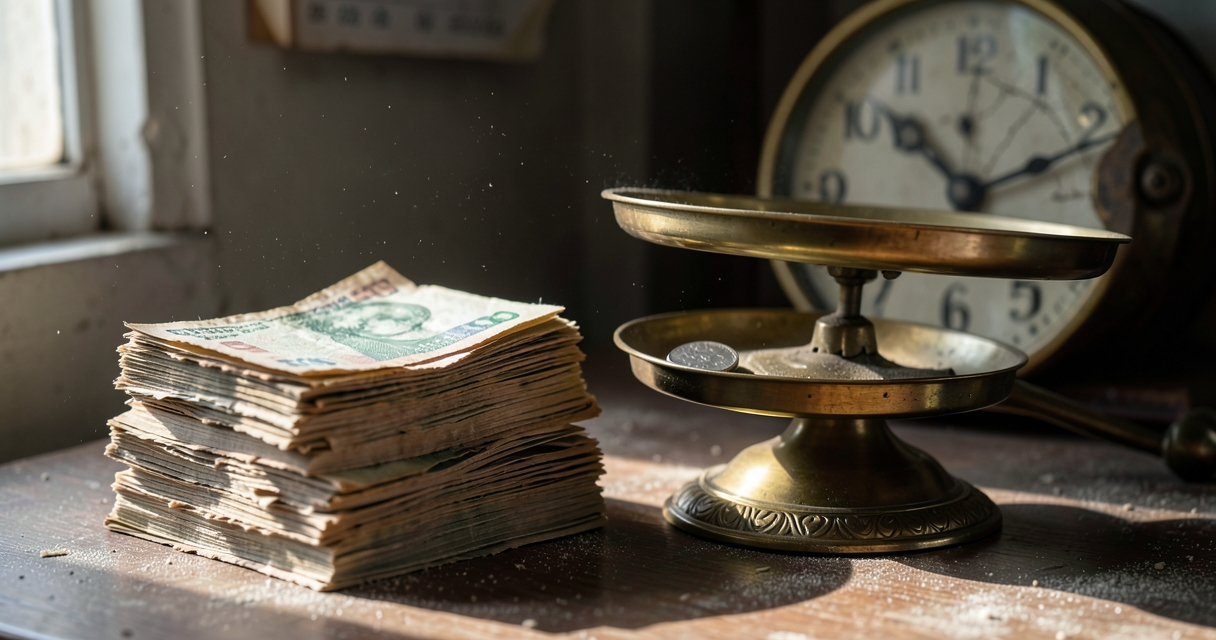
Cash feels safe because the number never changes. Put $10,000 in a drawer in 2020 and it is still $10,000 today. What changed is what it buys. According to the BLS consumer price index, $100 in 2020 has the same purchasing power as about $130.41 today — cumulative inflation of 30.41% since 2020, an average of 4.52% a year. A dollar today buys only 76.7% of what a dollar bought in 2020.
Run the same arithmetic on that drawer: $10,000 held untouched since 2020 now buys roughly what $7,670 bought back then (10,000 divided by 1.3041). Nothing was stolen and nothing crashed — the money simply covers less of the same basket. That is the sense in which inflation is a tax: it is collected quietly, a fraction of a percent at a time, with no bill and no due date.
This is also why a falling inflation rate is not the same as falling prices. When the annual rate drops from 6% to 3%, prices are still rising — just more slowly. The higher level stays. Getting your old purchasing power back would require actual deflation, which the U.S. has not seen in any sustained way in decades, and which brings problems of its own.
- October 2026 CPI+0.4% on the month (after +0.6% in September); core +0.3%
- Last 12-month rate3.7% headline, 2.6% core (September 2026; no October annual rate published)
- Since 2020$100 in 2020 ≈ $130.41 today; cumulative +30.41%
- Buying power leftA dollar buys 76.7% of what it bought in 2020
- CPI-U level337.511 (1982-84 = 100), October 2026
Not all prices move together
The headline number is an average, and averages hide the spread. Between 2020 and 2025, transportation prices rose 37.7% on BLS annual averages, food and beverages rose 27.3%, while apparel rose only 8.8%. A dollar spent on a car or a bus fare lost far more ground than a dollar spent on clothing — nearly four times as much, in fact.
Your personal inflation rate depends on your own basket. A household that drives long distances and eats out often felt the post-2020 surge much harder than the national average suggests; a household spending mostly on services whose prices moved slowly felt it less. That is why two people can honestly disagree about how bad inflation has been: they are measuring different baskets.
It also matters for wages. The BLS reported that average paychecks rose exactly as fast as prices in October 2026 — which means no real raise for the month. A pay rise only counts once it beats the price level; a 4% raise in a year prices rise 3.7% is a real gain of roughly 0.3%, not 4%.

Real vs nominal: the only return that counts
Every return has two versions: nominal, the number on the statement, and real, what is left after inflation. A savings account paying 4% nominal in a year when prices rise 3.7% — the last published annual rate, for September 2026 — leaves a real return of about 0.3%. The account grew, but its purchasing power barely moved. Cash in a drawer, earning 0%, loses the full inflation rate every year.
That simple subtraction is the most useful habit in personal finance: always ask what a return is worth after inflation. Stocks, bonds, property and cash all get judged the same way. None of this is a recommendation to buy or sell anything — it is a way of reading numbers honestly, so a gain that only looks like a gain does not fool you.
The defence against the silent tax is not a single product. It is keeping money working at a rate that at least keeps pace with prices, holding enough cash for emergencies without holding so much that inflation eats it, and remembering that the price level almost never goes back down. Educational content, not investment advice.
Sources
- U.S. Bureau of Labor Statistics, 2026-11-10
- U.S. Bureau of Labor Statistics, 2026-11-10
- Investopedia, 2026-10-14